What Is Snail Mucin, Actually? The Ingredient Explained
If you have spent ten minutes on skincare social media you have met snail mucin. It is the ingredient people either swear by or refuse to touch on principle. Both reactions usually come from not knowing what it actually is.
So here is the plain answer, without the marketing.
Snail mucin is the secretion a snail produces to move, protect itself and repair its own tissue. On an ingredient list it appears as snail secretion filtrate — the filtered, purified version of that secretion. The species used in most Korean skincare is the common garden snail, Cryptomphalus aspersa (also written Helix aspersa).
What is snail mucin made of?
This is the part that explains the hype. Snail mucin is not one active ingredient — it is a mixture of several that skincare already uses separately.
Glycoproteins and glycosaminoglycans. Large water-binding molecules that form a hydrating film on the skin surface. Hyaluronic acid belongs to this family, and it is present in snail mucin. Hyaluronic acid can hold around a thousand times its weight in water, which is why the ingredient feels immediately plumping.
Allantoin. A well-known soothing compound. It is one reason snail mucin tends to sit well on irritated or reactive skin rather than aggravating it.
Glycolic acid. The smallest alpha hydroxy acid, present naturally in the secretion. On its own, glycolic acid is a strong exfoliant that can irritate. Interestingly, laboratory work comparing snail secretion to pure glycolic acid on skin cells found the whole secretion was well tolerated while isolated glycolic acid was not — the other components appear to buffer it.
Peptides, antioxidants, zinc and manganese. Present in smaller amounts, and part of why the ingredient is studied for repair rather than just hydration.
That combination is unusual. You would normally buy a humectant, a soother and a mild exfoliant as three separate products.
What does the research actually show?
Honest answer first: snail mucin is genuinely studied, but it is harder to research than a single-molecule ingredient because it is a complex mixture. Here is what exists.
A 2008 study by Brieva and colleagues at the University of Alcalá isolated the bioactive fractions of Cryptomphalus aspersa secretion and mapped their effects on human skin cells, including fibroblast proliferation and production of extracellular matrix components.
A study by Fabi and colleagues found that a topical gel containing purified snail secretion improved the appearance of fine lines and wrinkles over twelve weeks of use.
Hydration has been measured directly. In one study, transepidermal water loss — how much moisture escapes the skin — dropped immediately after application and was still lower at one hour and at twenty-four hours.
A randomised placebo-controlled trial published in the Journal of Cosmetic Dermatology in 2022 tested a serum containing snail secretion filtrate alongside calendula and licorice root extract in people with mild to moderate mask-related breakouts.
What that adds up to: good evidence for hydration and skin comfort, promising evidence for the appearance of texture and fine lines, and early evidence in blemish-prone skin. It is a cosmetic ingredient, not a medicine, and nothing here means it treats or cures a skin condition.
How much snail mucin do you actually need?
This is where most products fail. Snail secretion filtrate can legally appear on a label at one percent, and it often does.
The clinical work showing results used formulations with high mucin content — around eighty percent and above. So the number on the front of the bottle is not marketing noise. A product listing snail secretion filtrate as the first ingredient is delivering something quite different from one where it sits near the preservatives.
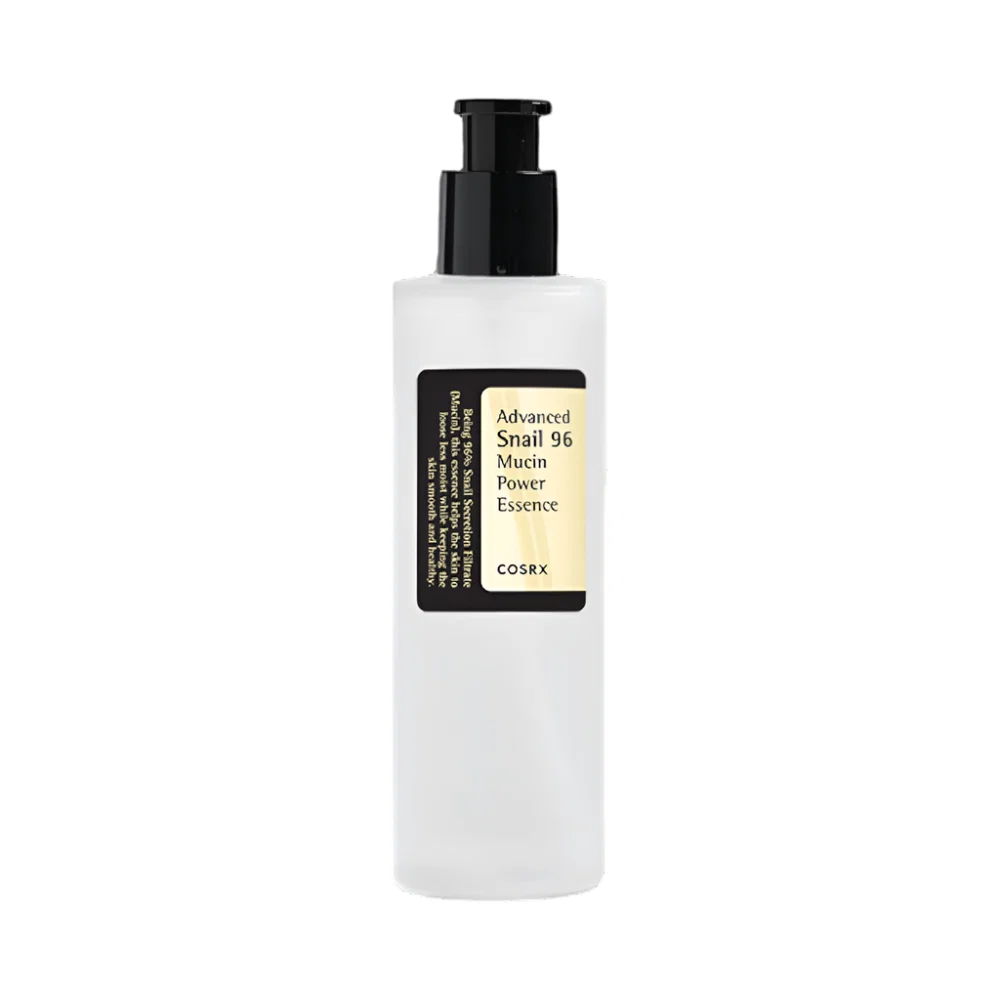
The COSRX Advanced Snail 96 Mucin Power Essence is the reference point for exactly this reason: 96.3 percent snail secretion filtrate, listed first, with betaine, sodium hyaluronate, allantoin and panthenol behind it. It is the product that introduced most of the world to the ingredient.
Is it cruelty-free?
Snails are not harmed in the collection process used by the major Korean brands — the secretion is gathered from snails kept in a dark, calm environment and left to move freely, then filtered and purified. That said, snail mucin is animal-derived, so it is not vegan. If that matters to you, it is worth knowing before you buy rather than after.
Who should be careful
Anyone with a known shellfish or dust mite allergy should approach snail mucin cautiously — there is some potential for cross-reactivity. And as with any new product, patch test on your inner forearm for twenty-four hours before putting it on your face. Our safety guidance covers this in more detail.
How to use it
Snail mucin sits after your toner and before your moisturiser. Two or three pumps, pressed rather than rubbed in, morning and night. It layers well under sunscreen and makeup because the texture is thin and absorbs quickly.
Expect hydration within days. Expect anything to do with texture or fine lines to take months of consistent use — that is true of every ingredient, and anyone promising faster is selling you something.
Ready to start your routine?
Take the 60-second skin quiz and get a routine built for you.
Take the Quiz →Products mentioned in this article
Authentic, shipped worldwide from Seoul.